

Quality Home Painting Services

Exterior Primers
Continuing our effort to innovate and bring a higher quality and longer lasting paint job to our customers, we have completely re-evaluated the old standard of using a basic oil-based primer on everything. It just makes sense when you consider the fact that primer is the very foundation of a new paint job, and not using the best products could result in a poor overall appearance, inadequate adhesion, stain bleed-through and ultimately, premature failure of the new paint.
In order for a primer to work the best it possibly can, it needs to offer the following features:
-Adhesion: The ability to penetrate and adhere to many different types and conditions of substrates for the life of the coating.
-Flexibility: The ability to expand and contract along with the natural movements of the substrate and any underlying/overlying paint films for the life of the coating.
-Breathability: The ability to allow water vapor to permeate the film, allowing internal moisture to escape without causing loss of adhesion, blistering or peeling.
-Stain resistance: The ability to block and seal out underlying stains such as wood tannins, knots, and rusty nail heads.
Standard oil-based primers adhere well to a variety of substrates and resist stains rather effectively, but they fall short in other critical areas. As they dry and age they become increasingly hard and brittle, which reduces their ability to flex with the substrate and causes them to lose adhesion and peel. Oil primers also do not breathe well, which can trap moisture behind the film and lead to additional blistering and peeling.
Therefore, we use a water-based acrylic product called XIM Peel Bond along with a shellac-based product called Zinsser BIN as our standard system for priming, which meets all of the requirements above and then some. Following is a brief explanation of these products and how we use them to provide the best possible basecoat for every home we paint:
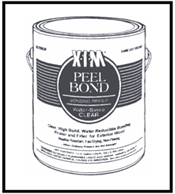
XIM PEEL BOND
XIM Peel Bond is our main surface primer and is the product that we nearly always recommend for the priming of a home exterior. Peel Bond is a unique, water-based acrylic-polymer primer that is formulated to penetrate, bond-to, and seal a wide range of construction materials while maintaining a high moisture-permeability rate for exceptional breathability. It is also very flexible and remains so for the life of the coating, allowing it to expand and contract with the substrate and under/overlying paint films without blistering or peeling. In addition, one of the most unique attributes of Peel Bond is the fact that it is formulated to be a high-build primer that fills and bridges rough surfaces, minor 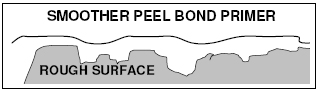 imperfections and cracks, and helps smooth the transitions between bare wood and existing paint. We apply it up to five times as thick as standard primers, depending on the requirements of the substrate, and it dries to a hazy-clear when it’s ready to paint.
ZINSSER “BIN” PRIMER
To prevent highly persistent stains from potentially bleeding through to our topcoat, we identify any areas of a home that may require additional attention such as rusty nail heads or wood knots, and spot prime them with BIN. BIN is an oil-shellac-based primer that is extremely effective at blocking these types of stains. We do this spot-priming during the scrape and preparation stage of the paint job, to allow for sufficient drying time prior to the application of Peel Bond primer.
OIL-BASED & SPECIALTY PRIMERS
Sometimes a painting project will require the use of additional oil-based or other specialty primers instead of our standard system of BIN and Peel Bond. following are some examples of common jobs and the product systems we recommend for them:
Staining
Whenever primer is requested or required with a solid-color staining job, we will always use a high quality oil-based primer mixed 30%-50% with Flood Penetrol. The use of oil primer/penetrol in this situation minimizes the film thickness of the primer coat, while still providing an exceptional base coat. The Penetrol is an additive that enhances the primer's ability to penetrate and stabilize these unsound substrates, while further reducing the prime-coat's effect on texture and look.
Weathered/Degraded Wood
If a home has severely weathered or degraded wood, and sanding to a fres substrate is undesired or infeasable, then high quality oil-based primer mixed 30%-50% with Flood Penetrol is the priming system we use. The Penetrol is an additive that enhances the primer's ability to penetrate deep and stabilize these unsound substrates, allowing for better durability and adhesion of the topcoats. If a smoother appearance is desired, we can also follow the Oil/Penetrol priming step with the addition of a full second prime coat of PeelBond prior to the topcoats.
Porch/Deck Floors
In the case of painted porch or deck floors, a high-quality oil-based primer is best since its hardness and durability can help the topcoat to withstand foot traffic better than a water-based acrylic. On these surfaces, we usually use an oil product from Cabot called Problem-Solver Deck Primer, which is specifically formulated for use on floors, porches and decks.
Metals & Other Specialty Surfaces
We use oil-based or specialized acrylic primers on roofs, galvanized metal, baked enamel finishes, aluminum, steel and any untreated metals as needed. The specific primer we use depends on the situation, and we rely on experience, research, and contact with product reps to stay on top of selecting the best products.
Whatever the job and whatever the substrate, you can count on us to ensure that the correct priming system is always used.